

When you are importing or exporting goods in the UAE, customs clearance is a must-have requirement. All shipments must go through customs before entering or leaving the country. And it can be very frustrating and even costly if you make small mistakes as the process is pretty straightforward once you get the hang of it.
- Key Takeaways
- What Is Customs Clearance and Why It Matters in the UAE
- Types of Customs Clearance in UAE
- Import vs Export Customs Clearance in UAE
- How the UAE Customs System Works
- What Documents Are Required for Customs Clearance?
- Step-by-Step Customs Clearance Process in Dubai
- Step 1: Business Registration & Importer Code Setup
- Step 2: HS Code Classification
- Step 3: Preparing and Submitting Customs Declaration
- Step 4: Duty & VAT Assessment
- Step 5: Inspection & Risk Channel Allocation (Green / Yellow / Red)
- Step 6: Payment of Duties and Charges
- Step 7: Final Clearance & Goods Release
- What Affects Customs Clearance Costs?
- Challenges in Customs Clearance
- Common Customs Clearance Mistakes
- Benefits of Working With a Customs Clearance Agent
- How to Choose the Right Customs Clearance Partner
- The Future of Customs Clearance in UAE
- FAQs About Customs Clearance in Dubai & UAE
- Conclusion
The good news is this: customs clearance strictly follows a clear system.It is easier to deal with when you are familiar with the steps, documents to be brought, and factors that influence the cost. In this guide, you will learn how customs clearance processes in the UAE will unfold, what is likely to happen at each stage, and how you can steer clear of the most typical issues.
Key Takeaways
- Customs clearance ensures legal and compliant trade in the UAE
- Accurate documentation and HS classification prevent delays
- Working with experienced agents reduces risk and saves time
What Is Customs Clearance and Why It Matters in the UAE
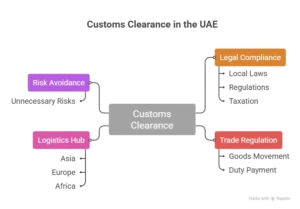
Clearing customs means formally informing the government about the goods that are coming into or going out of a country. It confirms that shipments are legally compliant with local laws, regulations, and taxation requirements.
In the UAE, customs plays a major role in regulating trade. Since the country serves as a major logistics hub connecting Asia, Europe, and Africa, efficient customs systems help keep trade moving smoothly. Proper clearance ensures goods move legally, duties are paid correctly, and businesses avoid unnecessary risk.
Types of Customs Clearance in UAE

The UAE handles several types of customs clearance depending on the shipment’s purpose.
There’s import clearance for goods entering the country. Export clearance applies to goods leaving the UAE. Transit clearance is the process that the goods undergo in the UAE when they are meant to be transported to a different place. Temporary admission refers to the situation where the goods are brought for exhibition, or they are to be used for a very short period
Each type has specific documentation and rules. Understanding which category applies to your shipment prevents confusion during declaration.
Import vs Export Customs Clearance in UAE

Import clearance focuses on verifying product value, origin, and applicable duties. Authorities calculate customs duty and VAT based on the declared value and HS code.
Export clearance, in contrast, is the procedure of making sure that the goods meet compliance with the export rules. Certain items may necessitate getting extra approvals or licenses before they can be shipped out of the country.
While both processes involve documentation and inspection, import clearance usually involves duty payment, while export clearance often focuses on regulatory compliance.
How the UAE Customs System Works
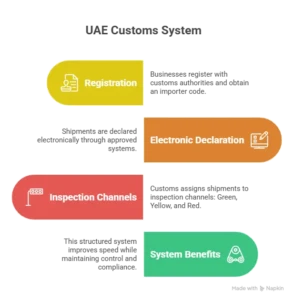
The UAE uses digital customs platforms to streamline declarations. Businesses register with customs authorities and obtain an importer code. Once registered, shipments are declared electronically through approved systems.
After submission, customs assigns shipments to inspection channels. Green channel shipments are cleared automatically. Yellow requires document review. Red requires physical inspection.
This structured system improves speed while maintaining control and compliance.
What Documents Are Required for Customs Clearance?

A commercial invoice, packing list, bill of lading or air waybill, and certificate of origin are the documents that are usually required for consignments of goods. Besides, goods belonging to some categories may require special permits and approvals.
It is very important to keep documentation accurate. Just a few errors in document details can postpone the clearance process. Keeping the details on invoices, HS codes, and declared values uniform will help the process to be uninterrupted.
Step-by-Step Customs Clearance Process in Dubai

Let’s break down how the process works in practical terms.
Step 1: Business Registration & Importer Code Setup
Prior to making imports, companies have to sign up with UAE customs authorities and get an importer code. Without registration, goods cannot be cleared legally.
Step 2: HS Code Classification
Each product is assigned a Harmonized System (HS) code. This code determines duty rates and regulatory requirements. Correct classification prevents underpayment or overpayment of duties.
Step 3: Preparing and Submitting Customs Declaration
The importer or customs agent makes a declaration via the digital portal. This consists of the shipment information, value, origin, and the attached documents.
Step 4: Duty & VAT Assessment
Customs calculates applicable duty and VAT. In most cases, the standard customs duty in the UAE is 5% of the CIF value, though certain products vary.
Step 5: Inspection & Risk Channel Allocation (Green / Yellow / Red)
Shipments are assigned a channel based on risk assessment. Green clears automatically. Yellow requires document review. Red involves physical inspection.
Step 6: Payment of Duties and Charges
Once assessed, duties and fees must be paid before goods are released.
Step 7: Final Clearance & Goods Release
After payment and approval, customs issues a release order. Goods can then leave the port or airport.
What Affects Customs Clearance Costs?

Several factors influence costs. Product type and HS code determine duty rates. Shipment value impacts VAT calculation. Storage charges may apply if clearance is delayed.
Other contributors to the overall costs are inspection fees, documentation charges, and port handling fees. Proper preparation is the way to prevent unexpected expenses.
Challenges in Customs Clearance
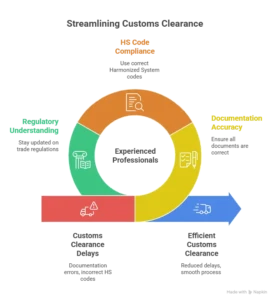
These issues usually delay the process: documentation errors, incorrect HS codes, and misunderstandings of regulations. Furthermore, businesses not familiar with compliance requirements may get confused by changing trade regulations.
Working with experienced professionals helps reduce these challenges significantly.
Common Customs Clearance Mistakes

One common mistake is undervaluing goods to reduce duty. This could result in penalties. Another thing that causes a problem is unfinished papers or mismatched invoice information.
Late submission of documents can even lead to the imposition of storage fees at ports or airports. Most of these problems can be addressed by planning and accuracy.
Benefits of Working With a Customs Clearance Agent

Customs officers are well-versed in the procedures, documentation, and regulatory changes. They also help ensure the correct classification of goods and the timely handling of submissions.
This reduces delays, prevents compliance errors, and saves time for businesses focused on operations.
How to Choose the Right Customs Clearance Partner

First of all, find a freight forwarder who has the expertise and experience in your industry. Second, confirm that the agent is well-versed in the customs regulations in the UAE. Last but not least, being transparent in pricing and communicating is the ultimate matter.
A trustworthy partner will be able to help you by describing the process clearly and informing you of everything as your goods move along the shipping chain.
The Future of Customs Clearance in UAE

The UAE continues to invest in digital transformation. Integrated digital trade systems, automation, and electronic documentation have resulted in faster and more transparent operations.
With the improvement of technology, customs clearance is not only becoming much quicker and more predictable but also more dependent on data.
FAQs About Customs Clearance in Dubai & UAE
How long does customs clearance take in Dubai?
It can take a few hours for green channel shipments. Inspections may take longer depending on complexity.
What is the standard customs duty in UAE?
Most goods are subject to 5% duty, but some categories differ.
Can I clear customs without an agent?
Yes, if registered. However, many businesses prefer agents to avoid errors.
Conclusion
Customs clearance in the UAE is a well-structured, digital process. It is very easy to handle if a business gets familiar with the documents needed, duty calculation method, and inspection procedures. Planning in advance and collaborating with experienced professionals help you avoid delays and unexpected costs. Customs clearance with the right approach should be just one of the steps of international trade, not the obstacle creating headache, anxiety, and stress.