

Overview
Shipping goods internationally means you can’t avoid customs clearance. Any shipment that comes into or goes out of a country has to be checked by customs. It is more than just filling out forms. It is a checkpoint where officials check the goods, assess their value, and ensure that the shipment complies with the country’s regulations.
- Overview
- Key Takeaways
- What Is Customs Clearance?
- Why Is Customs Clearance Important in Logistics?
- The Customs Clearance Lifecycle: From Shipment Creation to Final Delivery
- Phase 1: Pre-Shipment Compliance
- Phase 2: Declaration & Risk Assessment
- Phase 3: Financial Assessment
- Phase 4: Inspection & Release
- Phase 5: Post-Clearance Monitoring
- What Determines Whether a Shipment Clears Quickly or Gets Delayed?
- How Customs Clearance Costs Are Really Calculated
- Who Controls the Process? Roles and Responsibilities Explained
- How Customs Clearance Differs for Imports vs Exports
- What Happens After Customs Clearance?
- Frequently Asked Questions About Customs Clearance
- Conclusion
Initially, customs can seem very confusing to a lot of businesses. After all, there are forms, codes, duties, and inspections to deal with. However, once you get to know the system, handling it is a lot easier. This guide to customs clearance will help you understand the essence of customs clearance, its importance, the detailed process, and the factors that influence speed and cost.
Key Takeaways
- Customs clearance verifies compliance before goods cross borders
- Accurate documentation and HS classification prevent delays
- Preparation before shipment reduces clearance risk
What Is Customs Clearance?
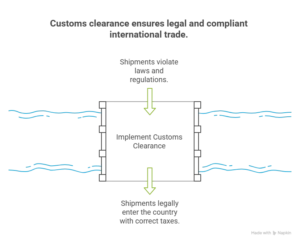
Customs clearance is the government-approved act of reporting items that cross borders internationally. Its purpose is to ensure that shipments comply with the laws, regulations, and taxes of the country.
When shipments reach a port, an airport, or a border crossing, customs agents examine the papers, verify product classifications, calculate the duties and taxes, and make a decision on whether an inspection is necessary or not. The goods can only be dispatched for delivery after the completion of this procedure.
Simply put, customs clearance works as a checkpoint. It guarantees that trade is conducted legally, transparently and that the correct amount of taxes is paid.
Why Is Customs Clearance Important in Logistics?

Customs clearance is one of the key elements of global logistics. It is hard to imagine shipping goods to another country without clearing customs first. You may have heard that the quickest shipping way doesn’t matter at all if the cargo is detained once it arrives at the border.
Proper clearance will be very helpful in several ways such as not postponing the work, not getting fined, and not getting into the compliance issues. Besides that, it is a good way for governments to get their dues of duties and VAT properly.
For logistics teams, smooth customs clearance keeps supply chains running. For businesses, it protects timelines, budgets, and customer satisfaction.
The Customs Clearance Lifecycle: From Shipment Creation to Final Delivery

Customs clearance is not just a single point in time, but a whole process that starts before shipment and continues on even after release.
Phase 1: Pre-Shipment Compliance
This phase occurs even before the products are shipped out from the warehouse. Companies check HS codes, make sure products meet regulations, prepare invoices, and verify that necessary permits are obtained.
Most issues arise at the time of declaration if compliance checks were bypassed at this stage.
Phase 2: Declaration & Risk Assessment
On arrival at the border, a customs declaration accompanies the shipment. The authorities examine the details of the shipment, the classification of the product, and the declared value.
Usually, the system assigns a risk channel at this point. For some shipments, there is an automatic clearance, while others are flagged for inspection or review.
Phase 3: Financial Assessment
Customs calculates duties and VAT based on the shipment’s declared value and HS code. Additional fees may apply depending on product type or origin.
Payment must be completed before goods can move forward.
Phase 4: Inspection & Release
If inspection is required, customs officers physically examine the shipment. They verify contents match declared documentation.
Once approved, customs issues a release order, allowing the goods to proceed to final delivery.
Phase 5: Post-Clearance Monitoring
Clearance doesn’t always end at release. Authorities may conduct audits later to verify compliance. Keeping accurate records protects businesses from future disputes or penalties.
What Determines Whether a Shipment Clears Quickly or Gets Delayed?
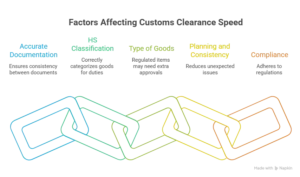
Several factors influence clearance speed. Accurate documentation is one of the biggest. Even small mismatches between invoice and packing list can trigger delays.
Correct HS classification also matters. If codes are incorrect, duties may be reassessed. The type of goods plays a role as well. Regulated products often require additional approvals.
Planning, consistency, and compliance reduce the risk of unexpected holds.
How Customs Clearance Costs Are Really Calculated

Generally, the expenses for customs clearance will be composed of customs duty, VAT, handling charges, and on some occasions, inspection fees as well.
The amount of the duty will be different depending upon the product HS code as well as its category. Most of the time the basis for VAT is the entire amount of the goods’ value, which therefore also includes the cost of freight and insurance.
The costs of storage may be charged in case the clearance is delayed. Being well informed about such factors enables firms to set their budget expectations more accurately.
Who Controls the Process? Roles and Responsibilities Explained
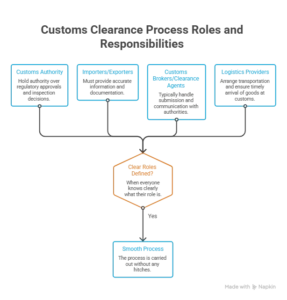
Customs hold the authority over regulatory approvals and inspection decisions. The importers or exporters must provide accurate information and documentation.
Customs brokers or clearance agents typically handle the submission and communication with the authorities. Logistics providers arrange transportation and make sure that the goods arrive at customs on time.
When everyone knows clearly what their role is, the process is carried out without any hitches.
How Customs Clearance Differs for Imports vs Exports
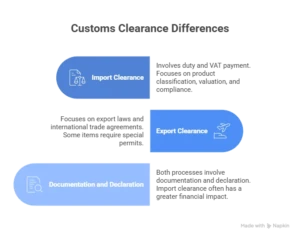
Import clearance usually involves duty and VAT payment. Authorities focus on product classification, valuation, and compliance with local regulations.
Export clearance focuses more on ensuring goods meet export laws and international trade agreements. Some items may require special export permits.
While both processes involve documentation and declaration, import clearance often carries greater financial impact.
What Happens After Customs Clearance?
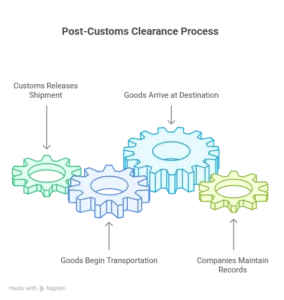
After the customs releases the shipment, the goods are on their way for final delivery. During this stage, transportation is ongoing to the warehouse or the end customer.
In any case, companies are still required to keep their records for audits and reporting. Clearance is a green light for the goods to be moved, but compliance obligations are still there.
Frequently Asked Questions About Customs Clearance
How long does customs clearance take?
It can take a few hours for low-risk shipments or several days if inspection is required.
Can shipments be cleared without a customs broker?
Yes, but many businesses prefer brokers to reduce errors and manage documentation.
What causes most customs delays?
Incorrect documentation, wrong HS codes, and missing permits are common causes.
Conclusion
Customs clearance is the process that makes it possible for goods to be transported legally and without any problems across the border. The process includes submitting documents, determining the amount of duty, and possibly inspection, but it follows a well-defined structure. Customs clearance will not be a hindrance to international trade if companies get ready in advance, correctly classify their products, and keep accurate records.
Collaborating with professional logistics companies such as TriRoute Shipping is always a helpful factor, as it can make the whole process much easier. Also, they assist businesses to face the requirements with certainty and at the same time keep the shipments timely.