
Customs clearance is where international shipments either move smoothly or grind to a halt.
- Key Challenges in Customs Clearance
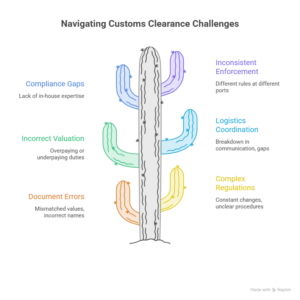
- 1. Incorrect or Incomplete Document Preparation
- Common Document Errors and How They Cause Delays
- Multi-Agency Documentation Requirements
- 2. Rapidly Changing and Complex Regulations
- How Regulatory Changes Impact Compliance Timelines
- Challenges in Emerging and Developing Markets
- 3. Incorrect Valuation and Improper Product Description
- HS Code Misclassification Consequences
- Valuation Disputes and How Authorities Assess Goods
- 4. Logistics Coordination and Communication with Authorities
- Coordinating Between Freight Forwarders, Brokers, and Customs
- Language and Communication Barriers with Customs Authorities
- 5. Compliance and Regulatory Assistance Gaps
- Keeping Up with Trade Compliance Requirements
- Risk of Penalties for Non-Compliance
- 6. Inconsistent Enforcement Across Ports and Markets
- Regional and Port-Level Variations in Customs Enforcement
- Infrastructure and Port-Level Constraints in Emerging Markets
- Solutions and Strategies to Overcome Customs Challenges
- Special Focus: Customs Challenges in Emerging Markets
- The Role of Technology in Modern Customs Clearance
- AI and Automation in Customs Declaration Processing
- Real-Time Monitoring and Live Shipment Visibility
- How Customs Software Reduces Errors and Speeds Up Clearance
- Frequently Asked Questions
- What are the most common customs clearance problems?
- Can I do customs clearance myself?
- How are customs charges calculated?
- What is the customs clearance process in the UAE?
- How do I avoid delays at customs?
- Conclusion
Most delays aren’t random. They come from the same handful of problems — wrong documents, misclassified goods, regulatory changes nobody flagged, or a communication breakdown somewhere in the chain.
This guide covers the key challenges in customs clearance, how they cause delays and costs, and what you can do to avoid them.
Key Takeaways
- Documentation errors cause most customs delays, and almost all of them are preventable with proper preparation before goods leave the origin country.
- HS code misclassification and valuation disputes are costly mistakes that proper upfront advice eliminates. The cost of getting it wrong always exceeds the cost of getting expert help first.
- Local expertise matters enormously in complex and emerging markets. Working with brokers who know the specific port, authority, and local regulations they’re dealing with is the most reliable way to keep shipments moving.
Key Challenges in Customs Clearance
1. Incorrect or Incomplete Document Preparation

Documentation errors are the single most common cause of customs delays. And they’re almost always avoidable.
Common Document Errors and How They Cause Delays
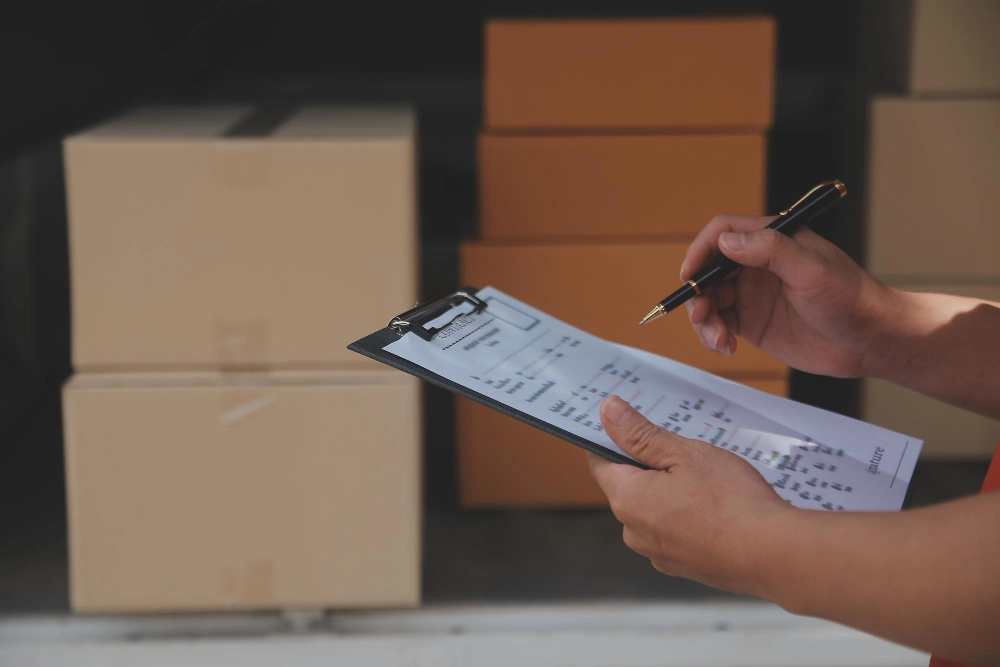
A mismatched value between the commercial invoice and packing list. A certificate of origin that doesn’t match the declared country. A bill of lading with the wrong consignee name.
Any one of these triggers a hold. Customs officers can’t release a shipment when the paperwork doesn’t add up — so everything stops until the error is identified and corrected.
The correction process takes time. Sometimes a day. Sometimes a week. Meanwhile, storage charges accumulate and delivery windows get missed.
Multi-Agency Documentation Requirements
Customs clearance doesn’t always involve just one authority. Depending on the product and destination, you might need approvals from health agencies, agriculture departments, standards bodies, or trade ministries — each with their own document requirements.
Missing one approval from one agency holds the entire shipment. And getting that approval after the fact, while goods sit at the port, is expensive and slow.
The fix is knowing every agency involved before the shipment leaves — not after it arrives.
2. Rapidly Changing and Complex Regulations
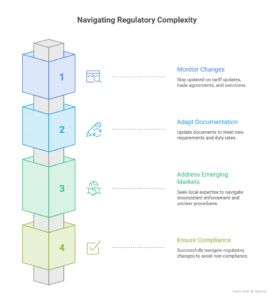
Trade regulations change constantly. Tariff updates, new trade agreements, sanctions changes, import restrictions — keeping up is a full-time job.
How Regulatory Changes Impact Compliance Timelines
A regulation that applied last month may not apply today. New documentation requirements, revised duty rates, or updated product restrictions can take effect quickly — sometimes with little public notice.
Businesses that aren’t monitoring these changes get caught out. A shipment prepared under last month’s rules can be non-compliant by the time it arrives at the border.
Challenges in Emerging and Developing Markets
Regulatory complexity is often highest in the markets where documentation and compliance systems are least mature.
Emerging markets may have inconsistent enforcement, unclear procedures, or regulations that exist on paper but are applied differently by different officers at different ports. That unpredictability is a real operational challenge for importers and exporters.
Local expertise in these markets isn’t optional — it’s the only reliable way to navigate effectively.
3. Incorrect Valuation and Improper Product Description
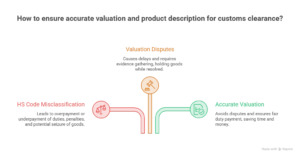
Getting the value and classification of goods wrong is one of the most costly mistakes in customs clearance.
HS Code Misclassification Consequences
Every product has an HS code — a standardised number that determines the duty rate and any applicable restrictions. Get it wrong and you’ve either overpaid duties or underpaid them.
Underpayment triggers penalties, duty recovery demands, and potential seizure of goods. Overpayment means you’ve left money on the table that you could have recovered.
HS code classification isn’t always straightforward. Some products sit between categories. When in doubt, formal classification advice from a customs expert is worth the cost.
Valuation Disputes and How Authorities Assess Goods
Customs authorities don’t just accept declared values at face value. They benchmark against market prices, transaction databases, and comparable shipments.
If your declared value looks too low, customs will challenge it. That triggers a valuation dispute — a time-consuming process that holds your goods while both sides gather evidence.
Accurate, consistent, and defensible valuation from the start avoids this entirely.
4. Logistics Coordination and Communication with Authorities
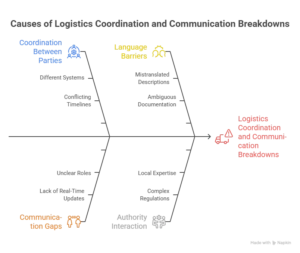
Customs clearance involves multiple parties — freight forwarders, customs brokers, port authorities, and the relevant government agencies. When coordination breaks down, shipments stall.
Coordinating Between Freight Forwarders, Brokers, and Customs
Each party in the chain has their own systems, timelines, and priorities. A document that needs to move from a freight forwarder to a customs broker to a port authority can get stuck at any handover point.
Gaps in communication between parties are a leading cause of avoidable delays. Clear roles, shared timelines, and real-time updates between all parties make a significant difference.
Language and Communication Barriers with Customs Authorities
In cross-border trade, language barriers create real compliance risk. A term that means one thing in an export declaration may be interpreted differently by an import authority in another country.
Mistranslated product descriptions, unclear certificates, or ambiguous documentation can all trigger holds that wouldn’t have occurred with clearer communication.
Working with locally experienced brokers who speak the language of the authorities they’re dealing with removes most of this risk.
5. Compliance and Regulatory Assistance Gaps
 Many businesses — especially smaller ones — don’t have dedicated trade compliance expertise in-house. That gap creates risk.
Keeping Up with Trade Compliance Requirements
Trade compliance isn’t static. Sanctions lists change. Free trade agreement rules of origin get updated. Product-specific regulations evolve.
Businesses that don’t have someone actively monitoring these changes will eventually get caught out — usually at the worst possible moment, with a high-value shipment stuck at a border.
Risk of Penalties for Non-Compliance
The cost of non-compliance goes beyond the immediate delay. Fines, duty recovery demands, loss of trusted trader status, and reputational damage with suppliers and customers all follow from repeated compliance failures.
For businesses operating at volume, even a small non-compliance rate across thousands of shipments adds up to a significant cost.
6. Inconsistent Enforcement Across Ports and Markets
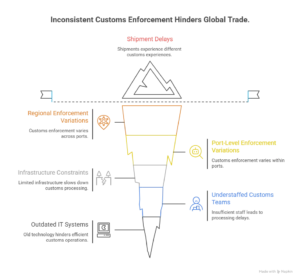
The same regulations can be enforced very differently depending on where and by whom.
Regional and Port-Level Variations in Customs Enforcement
Two shipments with identical documentation can have completely different experiences at different ports. One clears in hours. The other gets flagged for inspection and sits for days.
Port-level variation in interpretation and enforcement is a real phenomenon. Experienced brokers who know the specific port and its officers navigate this far more effectively than those who don’t.
Infrastructure and Port-Level Constraints in Emerging Markets
Physical infrastructure matters too. Ports with limited scanning equipment, understaffed customs teams, or outdated IT systems process shipments more slowly — regardless of how good your documentation is.
In these environments, building buffer time into your shipment timelines and working with experienced local agents is the most reliable way to manage expectations and avoid cascading delays.
What comes through across all of this is that customs delays are rarely bad luck — they’re the predictable result of gaps in documentation, communication, or local knowledge. That’s really the point of having a solid guide to Customs Clearance on hand: it turns a maze of agency requirements, valuation rules, and port-by-port quirks into something you can actually plan around.
Solutions and Strategies to Overcome Customs Challenges
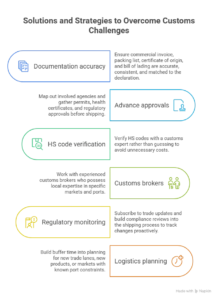
Most customs problems are preventable. Here’s what actually works.
A clear step-by-Step Customs Clearance Process makes it much easier to catch issues before they become costly delays.
Get documentation right before the shipment moves. Every document — commercial invoice, packing list, certificate of origin, bill of lading — needs to be accurate, consistent with each other, and matched to the declaration exactly. Check it before goods leave, not after they arrive.
Know every approval you need before you ship. Map out which agencies are involved for each product and destination. Gather permits, health certificates, and regulatory approvals in advance.
Verify your HS codes with a customs expert rather than guessing. The cost of getting this wrong far exceeds the cost of getting proper advice upfront.
Work with experienced customs brokers who know the specific markets and ports you’re trading through. Local expertise is genuinely irreplaceable in complex or unfamiliar markets.
Monitor regulatory changes continuously. Subscribe to trade updates for your key markets, work with advisors who track changes proactively, and build compliance reviews into your shipping process.
Build buffer time into your logistics planning. Especially for new trade lanes, new products, or markets with known port constraints.
Special Focus: Customs Challenges in Emerging Markets
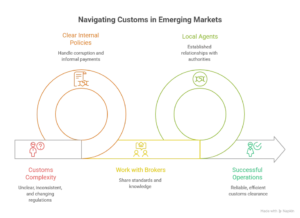
Emerging markets offer significant growth opportunities — and significant customs complexity.
Regulations may be unclear, inconsistently applied, or subject to rapid change without notice. Documentation requirements that aren’t clearly published can surface as a surprise at the border. This is where knowing the various types of customs clearance becomes especially useful, since different procedures carry different documentation risks.
Corruption and informal payments are a real operational risk in some markets. Businesses need clear internal policies on how to handle these situations and must work with brokers who share those standards.
Infrastructure limitations — port congestion, limited scanning capacity, manual processing — slow clearance times even when documentation is perfect.
The most effective approach in emerging markets is local partnership. Working with agents and brokers who have established relationships with local authorities and deep knowledge of how things actually work — not just how they’re supposed to work — is the most reliable way to operate successfully.
The Role of Technology in Modern Customs Clearance

Technology is changing how customs clearance works — and reducing the impact of many traditional challenges.
AI and Automation in Customs Declaration Processing
AI tools can check declarations for errors before submission, flag HS code mismatches, and verify that documentation is complete and consistent. What used to require hours of manual review gets done in minutes.
Automated declaration processing also reduces the risk of human error — the single biggest source of clearance delays.
Real-Time Monitoring and Live Shipment Visibility
Modern logistics platforms give importers and exporters real-time visibility into exactly where their shipment is in the clearance process. When a hold occurs, everyone in the chain knows immediately and can respond.
That speed of response makes a meaningful difference to how quickly issues get resolved.
How Customs Software Reduces Errors and Speeds Up Clearance
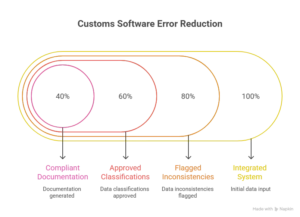
Integrated customs software connects your product data, documentation, and HS codes in a single system. It flags inconsistencies before submission, stores approved classifications for repeat shipments, and generates compliant documentation automatically.
For businesses shipping at any significant volume, this kind of software isn’t a luxury — it’s a practical necessity.
Frequently Asked Questions
What are the most common customs clearance problems?
Incorrect or incomplete documentation, wrong HS codes, undervalued goods, missing permits or approvals, and regulatory changes that weren’t picked up before shipment. Documentation errors cause the majority of avoidable delays.
Can I do customs clearance myself?
In many countries, yes — if your business is registered and holds the right credentials. But for complex products, regulated goods, or unfamiliar markets, working with a licensed customs broker is almost always the better choice. The risk of getting it wrong is too costly.
How are customs charges calculated?
Most countries use CIF — Cost, Insurance, Freight — as the basis for duty calculation. The applicable duty rate is determined by your HS code and the country of origin. VAT or other taxes may then apply on top.
What is the customs clearance process in the UAE?
Shipments are declared through the UAE’s electronic customs system — either Dubai Customs, Abu Dhabi Customs, or the relevant emirate authority. Documents are reviewed, duties assessed and paid, and goods inspected if required before being released.
How do I avoid delays at customs?
Prepare complete, accurate documentation before goods move. Verify HS codes. Know which permits and approvals are required. Work with experienced brokers for complex lanes. And don’t leave any of this until the shipment has already arrived.
Conclusion
Customs clearance challenges are real — but most of them are manageable with the right preparation, the right expertise, and the right systems in place.
Documentation errors, HS code mistakes, and regulatory blind spots cause the vast majority of delays and extra costs. All three are preventable.
The businesses that handle customs clearance well don’t do it by luck. They invest in accurate processes, experienced people, and technology that keeps everything consistent and compliant.
At Triroute, we help businesses navigate customs clearance across complex trade lanes — from documentation preparation and HS code verification to end-to-end freight management that keeps shipments moving without unnecessary delays.