

Choosing a customs clearance partner feels straightforward until something goes wrong. A shipment is held at the port. A penalty for a misclassified product. A broker who went quiet when you needed answers.
- Key Factors to Consider When Choosing a Customs Clearance Partner
- First: Licenses, Permits and Accreditation
- Verifying the Commercial Trade Licence
- Confirming Registration with Dubai Customs
- Financial Guarantees and Compliance
- Second: Experience and Reputation
- Years of Experience in UAE and Dubai Customs
- Track Record with Your Specific Product Category or Industry
- Client Testimonials and Case Studies
- Third: Range of Services Provided
- End-to-End Clearance vs Filing-Only Services
- Handling Both Imports and Exports
- Specialist Handling for Restricted or Regulated Goods
- Fourth: Knowledge of Customs Regulations and Legislation
- Staying Updated on UAE Customs Law Changes
- Expertise in HS Codes and Tariff Classification
- Compliance with GCC and International Trade Regulations
- Fifth: Technology and Innovative Solutions
- Automation and Digital Customs Declaration Tools
- Real-Time Shipment Tracking and Live Monitoring
- Integration with Your Existing Logistics or ERP Systems
- Sixth: Global Coverage and Network
- Strength of Relationships with Customs Authorities
- Network of Agents Across Ports and Free Zones
- Capability to Handle Cross-Border and Multi-Country Shipments
- Seventh: Cost of Services
- Understanding the Full Cost Breakdown — Not Just the Filing Fee
- How to Compare Quotes Across Brokers Fairly
- Balancing Cost vs Compliance Risk
- Eighth: Customer Support and Communication
- Dedicated Point of Contact vs Shared Support Queues
- Responsiveness During Holds, Delays, and Inspections
- Transparency in Reporting and Status Updates
- What Does a Customs Clearance Agent Actually Do?
- Staff Qualifications and Expertise to Look For
- Questions to Ask Before You Hire a Customs Clearance Partner
- Are You Licensed and Registered with Dubai Customs?
- What Experience Do You Have with My Product Type or Industry?
- How Do You Handle HS Code Classification Disputes?
- What Happens if My Shipment is Held or Inspected?
- Do You Offer Integrated Freight and Customs Clearance Services?
- How Do You Stay Updated on Changing Customs Regulations?
- What Are Your Fees and What Exactly is Included?
- Why Bundle Customs Clearance With Your Freight Forwarder
- Start With Compliance — Not Just Cost
- Conclusion
The right partner prevents all of that. The wrong one costs you more than their fees.
This guide covers exactly what to look for, what to ask, and how to make a decision you won’t regret.
Key Takeaways
- Always verify licensing and Dubai Customs registration before anything else. A broker without the right credentials creates compliance risk from day one.
- Experience in your specific product category matters as much as general customs knowledge. Ask for evidence, not assurances.
- Cost is one factor — not the deciding one. A cheap broker who causes delays and compliance errors will cost you more than a thorough one who gets it right consistently.
Key Factors to Consider When Choosing a Customs Clearance Partner

First: Licenses, Permits and Accreditation
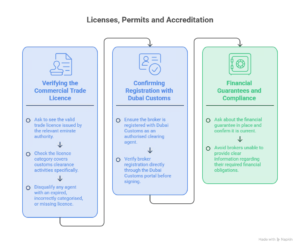
This is non-negotiable. Before anything else, verify that the broker you’re considering is properly licensed and authorised to operate.
Verifying the Commercial Trade Licence
Any legitimate customs clearance agent in the UAE must hold a valid trade licence issued by the relevant emirate authority. Ask to see it. Check the licence category covers customs clearance activities specifically.
A licence that’s expired, incorrectly categorised, or missing entirely is an immediate disqualifier — regardless of how impressive everything else looks.
Confirming Registration with Dubai Customs
For shipments through Dubai, your broker must be registered with Dubai Customs as an authorised clearing agent. This registration is separate from a trade licence and confirms the broker has met Dubai Customs’ specific requirements.
You can verify broker registration directly through the Dubai Customs portal. Do this before you sign anything.
Financial Guarantees and Compliance
Licensed customs brokers in the UAE are required to maintain financial guarantees with the relevant customs authority. These guarantees protect businesses if a broker fails to pay duties or meet obligations on your behalf.
Ask about the guarantee in place and confirm it’s current. A broker who can’t provide this information clearly isn’t operating to the standard you need.
Second: Experience and Reputation
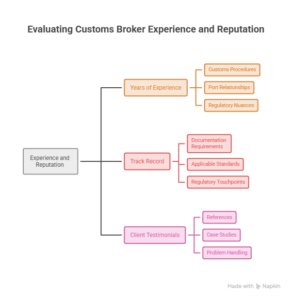
Licensing tells you a broker is authorised to operate. Experience tells you whether they’re actually good at it.
Years of Experience in UAE and Dubai Customs
Customs procedures, port relationships, and regulatory nuances take years to learn properly. A broker with deep UAE experience navigates holds, inspections, and edge cases far more effectively than one who’s still learning the system.
Ask specifically about their experience in the UAE — not just general freight or international trade experience.
Track Record with Your Specific Product Category or Industry
Customs complexity varies enormously by product type. Electronics, pharmaceuticals, food products, chemicals, and machinery each carry their own documentation requirements, applicable standards, and regulatory touchpoints.
A broker experienced in your specific product category will know exactly what’s required before you ask. One who isn’t will be learning on your shipments.
Client Testimonials and Case Studies
Ask for references from clients in your industry. A broker confident in their track record will have no hesitation providing them.
Look for evidence of how they handled problems — not just smooth clearances, but holds, disputes, and inspections. That’s where the real quality of a broker shows.
Third: Range of Services Provided

Not all customs brokers offer the same scope of service. Knowing what you actually need before you compare providers saves a lot of time.
End-to-End Clearance vs Filing-Only Services
Some brokers handle the full process — documentation preparation, submission, duty payment, coordination with port authorities, and release. Others only file the declaration and leave everything else to you.
For most businesses, especially those new to a trade lane, end-to-end service is worth the additional cost. Filing-only services require you to manage significant parts of the process yourself.
Handling Both Imports and Exports
If your business involves both importing and exporting, working with a broker who handles both under one roof simplifies coordination significantly.
Separate brokers for imports and exports creates handover gaps and makes it harder to maintain consistent compliance standards across your full trade operation.
Specialist Handling for Restricted or Regulated Goods
If you’re importing controlled substances, food products, medical devices, electronics subject to ESMA standards, or other regulated categories, you need a broker with specific experience in those product types. Understanding the different customs clearance types involved can help you match the right broker to the right category from the start.
Handling restricted goods incorrectly doesn’t just cause delays — it can result in seizure, penalties, and loss of import privileges.
Fourth: Knowledge of Customs Regulations and Legislation

A licensed broker who doesn’t stay current with regulations is a liability, not an asset.
Staying Updated on UAE Customs Law Changes
UAE customs regulations evolve. Tariff updates, new free trade agreement provisions, changes to restricted goods lists — these happen regularly and can affect your shipments with little warning.
Ask how your potential partner stays current with regulatory changes and how they communicate relevant updates to clients. The answer tells you a lot about how seriously they take compliance.
Expertise in HS Codes and Tariff Classification
Correct HS code classification is one of the most consequential things a customs broker does. Get it wrong and you face duty miscalculations, penalties, and potential seizure.
Ask about their classification process. Do they have in-house expertise? Do they use formal rulings or seek advance classification decisions for complex products? A broker who treats HS codes casually is one who will eventually create an expensive problem for you.
Compliance with GCC and International Trade Regulations
If you’re trading across GCC borders or importing from countries with which the UAE has free trade agreements, your broker needs to understand those frameworks.
Rules of origin requirements, preferential duty rates, and bilateral trade agreement provisions all affect your cost and compliance position. A broker without this knowledge leaves value on the table.
Fifth: Technology and Innovative Solutions

The quality of a broker’s technology directly affects how efficiently your shipments move and how visible you are throughout the process.
Automation and Digital Customs Declaration Tools
Manual declaration processing is slower and more error-prone than automated systems. Brokers using digital tools and automated workflows process declarations faster, catch errors before submission, and maintain better audit trails.
Ask what systems they use and how declarations are prepared and submitted.
Real-Time Shipment Tracking and Live Monitoring
You should always know where your shipment is in the clearance process. Real-time tracking means problems get flagged immediately — not hours later when the storage charges have already started accumulating.
A broker without live monitoring capability leaves you dependent on phone calls and emails to find out what’s happening.
Integration with Your Existing Logistics or ERP Systems
For businesses managing significant import or export volumes, integration between your customs broker’s systems and your own logistics or ERP platform is a major efficiency gain.
It removes manual data entry, reduces errors, and gives you a single source of truth for shipment status and costs.
Sixth: Global Coverage and Network

Your customs partner’s network determines how effectively they can support you across different ports, free zones, and countries.
Strength of Relationships with Customs Authorities
Strong working relationships with customs officers and port authorities accelerate clearance and help resolve issues faster when they arise. This kind of relationship capital takes years to build and is genuinely valuable.
Ask about their specific relationships at the ports and free zones most relevant to your business.
Network of Agents Across Ports and Free Zones
If your shipments move through multiple UAE ports or free zones, your broker needs either direct presence or strong agent relationships at each one. A broker with deep expertise at Jebel Ali but no real capability at Abu Dhabi Port creates gaps in your operation.
Capability to Handle Cross-Border and Multi-Country Shipments
If your supply chain involves multiple countries, your broker should be able to support you across all of them — either directly or through a reliable international network.
A broker who only operates effectively in one country becomes a bottleneck the moment your trade lanes expand.
Seventh: Cost of Services

Cost matters. But understanding what you’re actually comparing when you look at quotes matters more.
Understanding the Full Cost Breakdown — Not Just the Filing Fee
The filing fee is one line in a customs clearance invoice. There are also handling fees, documentation charges, coordination fees, and potentially storage and demurrage costs if clearance takes longer than expected.
Ask for a full cost breakdown before you compare quotes. A low filing fee attached to a long list of add-ons isn’t actually cheaper.
How to Compare Quotes Across Brokers Fairly
Make sure every quote covers the same scope of services. Compare like for like — end-to-end service against end-to-end service, filing-only against filing-only.
Also factor in what’s not costed. A cheap broker who regularly causes delays will cost you more in port storage, missed delivery windows, and operational disruption than a slightly more expensive one who gets it right consistently.
Balancing Cost vs Compliance Risk
The cheapest customs broker is rarely the best value. Compliance errors, misclassifications, and missed permits create costs that dwarf any saving on broker fees.
Make cost one factor in your decision — not the deciding factor.
Eighth: Customer Support and Communication

When something goes wrong at customs — and at some point, something always does — the quality of your broker’s communication is what determines how quickly it gets resolved.
Dedicated Point of Contact vs Shared Support Queues
A dedicated account manager who knows your business, your products, and your trade lanes responds faster and more effectively than a shared support queue where every call starts with explaining your situation from scratch.
Ask specifically whether you’ll have a dedicated contact and how they’re reachable.
Responsiveness During Holds, Delays, and Inspections
When a shipment is held for inspection or a documentation issue surfaces, response time is everything. Hours of delay become additional storage charges and missed delivery windows.
Ask how they handle urgent situations. Ask what their typical response time is when a hold occurs. The answer tells you what to expect when it matters most.
Transparency in Reporting and Status Updates
You shouldn’t have to chase your broker for updates. Proactive reporting — regular status updates, clear communication when issues arise, and transparent explanation of what’s happening and why — is the standard you should expect.
Ask what reporting looks like in practice before you commit.
What comes through here is that picking a customs partner isn’t really about finding the cheapest quote — it’s about finding someone whose licensing, experience, and communication style you can actually trust when something goes wrong at the border. Good customs clearance in freight forwarding depends on all of these pieces working together consistently.
What Does a Customs Clearance Agent Actually Do?

A customs clearance agent acts as your authorised representative with customs authorities. They prepare and submit customs declarations, ensure your documentation is complete and compliant, calculate and arrange payment of applicable duties and taxes, and coordinate with port authorities to secure release of your goods.
For regulated or restricted products, they also manage the permit and approval process with the relevant agencies.
A good agent does all of this proactively — flagging potential issues before they become problems, rather than reacting after a hold has already occurred.
Staff Qualifications and Expertise to Look For

The quality of a customs broker comes down to the people doing the work.
Look for staff with formal customs and trade qualifications, direct experience with UAE customs systems, and specific knowledge of your product category or industry. Ask whether the people handling your account are senior enough to make decisions when problems arise — or whether every issue needs to be escalated before anything moves.
Also ask about staff turnover. High turnover in a customs brokerage means institutional knowledge walks out the door regularly, which affects service consistency.
Questions to Ask Before You Hire a Customs Clearance Partner
Are You Licensed and Registered with Dubai Customs?
The baseline question. The answer should be an immediate yes, accompanied by willingness to share documentation. Any hesitation is a red flag.
What Experience Do You Have with My Product Type or Industry?
You want specific experience — not general customs knowledge. Ask for examples of similar clients and similar product types they’ve handled successfully.
How Do You Handle HS Code Classification Disputes?
A confident, detailed answer here indicates real expertise. A vague or dismissive one suggests classification isn’t taken as seriously as it should be.
What Happens if My Shipment is Held or Inspected?
Ask about their process, their response time, and who you’ll be speaking to. This question reveals how prepared they are for the situations that matter most.
Do You Offer Integrated Freight and Customs Clearance Services?
If you want to simplify your logistics operation, a partner who handles both freight and clearance under one roof is worth prioritising. Ask specifically about how the two services are coordinated.
How Do You Stay Updated on Changing Customs Regulations?
Look for a structured answer — subscriptions to regulatory updates, internal training, relationships with customs authorities. Not just “we keep an eye on things.”
What Are Your Fees and What Exactly is Included?
Ask for a complete fee schedule. Ask what triggers additional charges. Make sure you understand exactly what you’re paying for before you commit.
Why Bundle Customs Clearance With Your Freight Forwarder

Managing freight and customs clearance through separate providers creates coordination gaps. Documents need to move between parties. Communication can break down at handover points. When something goes wrong, both parties can point at each other.
Bundling both services with one provider — or with providers who have a deeply integrated relationship — removes those gaps. One point of contact for the full journey. Shared visibility across the shipment. Faster resolution when issues arise.
For businesses shipping at any real volume, integrated freight and customs clearance is almost always the more efficient model.
Start With Compliance — Not Just Cost
The businesses that choose customs partners based primarily on price often end up paying more overall — in penalties, delays, storage charges, and the cost of fixing classification errors.
The right starting point is compliance. Does this broker have the licence, the knowledge, the systems, and the experience to keep your shipments compliant and moving?
Cost is part of the picture. But a broker who keeps your goods moving, your duties accurate, and your documentation clean is worth more than one who files cheaply and creates problems you then have to pay to fix.
Conclusion
Choosing the right customs clearance partner is one of the most important logistics decisions your business makes. Get it right and your supply chain runs smoothly. Get it wrong and you’re dealing with delays, penalties, and disruption at the worst possible times.
Check the licence first. Then look at experience, service scope, technology, and communication quality. Ask the hard questions before you commit — not after a shipment is already held at the port.