

Introduction
Goods crossing a border have to pass through customs. This allows customs to check that shipments comply with the regulations of the destination country. It additionally guarantees that the correct duties, taxes, and documents are ready and available, prior the goods entering or leaving the country.
- Introduction
- Key Takeaways
- How to Determine the Right Type of Customs Clearance
- Nature of Goods
- Country of Origin and Destination
- Trade Regulations
- Main Types of Customs Clearance
- Import Customs Clearance
- Export Customs Clearance
- Transit Customs Clearance
- Temporary Import or Export Clearance
- Free Zone Customs Clearance
- Customs Clearance Process Explained
- Documents Required for Different Types of Customs Clearance
- Commercial Invoice
- Bill of Lading or Airway Bill
- Packing List
- Import or Export Licenses
- Special Customs Clearance Procedures
- Bonded Warehouse Clearance
- Duty Drawback Clearance
- Customs Clearance Under Special Procedures
- Common Challenges in Customs Clearance
- Conclusion
Customs clearance may seem complex initially, however it is a well-defined process. However, the requirements for clearance can vary significantly depending on both the nature of the goods and the origin and destination points. Understanding the different types can help business operate the movement of the goods seamlessly and to avoid unreasonable delays of the cargo.
Key Takeaways
- Customs clearance is the process of submitting all required documents, remitting duties, and undergoing inspections to ensure that goods are legally allowed to enter or exit a country.
- Different types of shipment clearance processes are required to clear different categories of shipments. For instance, import, export, transit, temporary, and free zone customs clearance.
- With the help of proper documentation and a clear understanding of trade regulations, businesses can prevent delays and ensure the smooth flow of their shipments.
How to Determine the Right Type of Customs Clearance
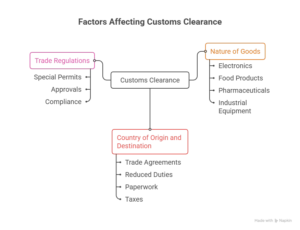
Not every shipment follows the same customs procedure. The type of clearance usually depends on a few important factors.
Nature of Goods
The type of product shipped is the biggest factor affecting the customs processing. Electronics, food products, pharmaceuticals, and industrial equipment might each be subject to different regulations.
Certain goods require extra documentation or inspections before they are cleared.
Country of Origin and Destination
Customs rules vary from country to country. A shipment traveling between two specific countries may qualify for trade agreements or reduced duties.
The origin and destination of goods often influence the paperwork and taxes involved in the clearance process.
Trade Regulations
Each country sets its own trade policies and import restrictions. Some products require special permits or approvals before entering a market.
Businesses must check these regulations carefully to make sure their shipments comply with the rules.
Main Types of Customs Clearance
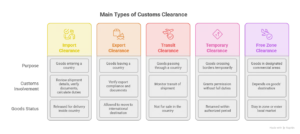
Customs clearance is not a single process. It includes several different types depending on how the goods are moving across borders.
Import Customs Clearance
Import clearance is the official procedure of allowing products to enter a country’s territory from abroad. Customs officers review shipment details, verify the documents, and calculate the duties or taxes.
The goods will be released for delivery inside the country only after all the payments and checks are thoroughly made and completed.
Export Customs Clearance
Export clearance is a process where customs officials are involved in the shipment of goods out of a country for international transportation. They verify that the export complies with the country’s laws and that the proper documents are provided.
After approval, the cargo is allowed to move to its international destination.
Transit Customs Clearance
Transit clearance is used when goods want to pass through a country’s territory while being transported to another destination.
Here, the goods are not for sale in the country where they are currently located. The customs officers merely keep an eye on the transit of the shipment through the country.
Temporary Import or Export Clearance
Sometimes goods cross borders temporarily. Examples include exhibition equipment, trade show displays, or machinery used for short-term projects.
Temporary clearance grants these goods permission to enter or exit a country without full payment of import duties, provided that they are returned within the authorized period.
Free Zone Customs Clearance
Free zones are designated commercial areas where products may be kept, handled, or re-exported without the usual import tariffs.
Depending on whether the goods stay in the zone or enter the local market, customs clearance in free zones will be done according to different procedures.
Customs Clearance Process Explained
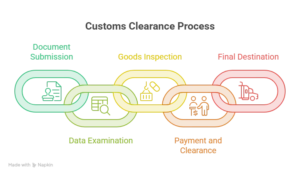
The customs clearance process involves several key steps.
Firstly, customs authorities get the shipment details and the relevant documents, which describe the goods, their value, and their destination.
Next, customs officials examine the data and calculate the duties or taxes. Besides, some carries get inspections to double-check that the goods really correspond to the declaration.
Once the review and payments are completed, the shipment receives clearance. At that point, the goods can move forward to their final destination.
Documents Required for Different Types of Customs Clearance

Accurate documentation is one of the most important parts of customs clearance. Missing or incorrect paperwork often causes delays.
Commercial Invoice
The commercial invoice describes the goods being shipped and their value. Customs authorities use it to calculate duties and taxes.
Bill of Lading or Airway Bill
This document acts as proof of shipment. It shows the transportation details and confirms that the cargo has been handed to the carrier.
Packing List
The packing list provides detailed information about how goods are packed, including quantities, weight, and packaging details.
Import or Export Licenses
Certain goods require special licenses before they can cross borders. These licenses confirm that the shipment follows national trade regulations.
Special Customs Clearance Procedures

Some shipments follow special customs procedures depending on how the goods are stored or processed.
Bonded Warehouse Clearance
Bonded warehouses allow goods to be stored without paying duties immediately.
Import duties are only paid when the goods leave the warehouse and enter the local market.
Duty Drawback Clearance
Duty drawback schemes enable companies to claim back the duties they have paid on imported items, in case those items are subsequently exported.
This process helps companies reduce costs when participating in international trade.
Customs Clearance Under Special Procedures
Some industries operate under special customs programs designed to simplify trade.
Such procedures may allow quicker customs clearance, lower taxes or duties, or relaxed documentation requirements for certain shipments.
Common Challenges in Customs Clearance
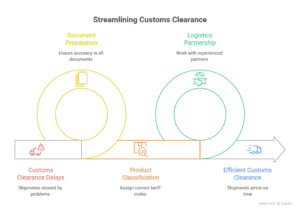
Customs clearance can sometimes slow down shipments if problems arise.
One of the most frequent problems is the use of the wrong documents to support the transaction. If there are errors in the invoice or packing list, even tiny ones, it could lead to delays in getting them approved.
Product classification can also cause problems. If goods are assigned the wrong tariff code, customs may hold the shipment until the issue is corrected.
In fact, last-minute inspections could bring more work to the process, adding time. Some cargo types are used to inspections, but these can be the cause of longer delivery times.
You can work with experienced logistics partners and prepare the documents carefully to help minimize these problems.
Conclusion
Customs clearance is an important aspect of international trade. It ensures the shipment meets all the legal requirements, that duties are levied fairly, and that the goods are transported safely from one country to another.
Familiarising oneself with the types of customs clearance will help a company prepare its shipments properly and prevent delays caused by customs processing. Having the correct paperwork and complying with the rules will significantly facilitate the operations.
Many companies choose to work with experienced logistics providers like TriRoute Shipping to manage customs procedures efficiently and keep international shipments moving without complications.