


Shipping goods into the UAE isn’t complicated — but customs clearance is the part that trips most people up. Miss a document, classify a product wrong, or underestimate duties, and your shipment sits at the port while costs pile up.
- Key Takeaways
- Step-by-Step Customs Clearance Process
- Step 1: Submit Documents for Pre-Declaration
- Step 2: Customs Officer Examines Paperwork and Verifies Goods
- Step 3: Import Duties and Taxes Are Assessed
- Step 4: Payment of Duties and Taxes Is Requested and Made
- Step 5: Inspection and Physical Examination (If Triggered)
- Step 6: Shipment Is Cleared and Released for Delivery
- Key Documents Required for Customs Clearance
- Mandatory Documents
- Additional Documents Required Based on Product Type or Destination
- Document Verification and What Customs Officers Check
- Duties, Taxes & HS Codes
- How Import Duties and Taxes Are Calculated
- What HS Codes Are and Why Correct Classification Matters
- Who Pays Customs Charges — Importer vs Exporter (Incoterms)
- How to Use a Duties and Taxes Calculator Before Shipping
- 2025–2026 Tariff Changes Importers Need to Know
- How Long Does Customs Clearance Take?
- Common Challenges That Cause Holds, Delays & Extra Fees
- Tips for a Smooth Customs Clearance Process
- Get Your Paperwork in Order Before Shipping
- Be Aware of Applicable Duties and HS Codes
- Consider Switching to DDP (Delivered Duty Paid) for B2C Lanes
- Pre-Determine Taxes Using a Duties Calculator
- Keep Commodity Data Reusable and Standardized
- Use Technology to Automate Customs Compliance
- The Role of a Customs Broker / Clearing Agent
- What to Do If Your Shipment Is Stuck at Customs
- Frequently Asked Questions
- What does customs clearance mean?
- How long does customs clearance take?
- Do I need a customs broker?
- Can I organise customs clearance myself?
- Are customs fees avoidable?
- Conclusion
In this detailed guide to customs clearance process, you will learn everything about the process of UAE customs clearance, the required documents, the method of calculating duties, and the appropriate steps to take if any issues arise. No matter if you are bringing goods into the country for the very first time or improving the efficiency of a procedure that is already in place, the information provided here will be helpful to you.
Key Takeaways
UAE customs clearance typically takes one to three days — complete, accurate documentation is the single biggest factor in how fast your shipment moves.
Correct HS codes and consistent documents are what separate smooth clearances from costly delays and penalties.
A licensed customs broker saves time, reduces risk, and is worth it for most importers — especially on new trade lanes or regulated products.
Step-by-Step Customs Clearance Process
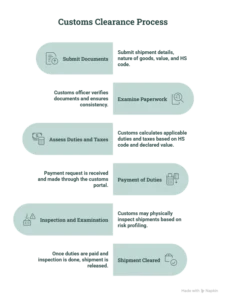
Every shipment entering the UAE goes through a defined process. Here’s how it works from start to finish.
Step 1: Submit Documents for Pre-Declaration
Before your goods arrive, you or your customs broker submits a pre-declaration through the UAE’s electronic customs system — Dubai Customs, Abu Dhabi Customs, or the relevant emirate authority.
This includes shipment details, the nature of goods, their value, and the HS code. Getting this right upfront saves a lot of headaches later.
Step 2: Customs Officer Examines Paperwork and Verifies Goods
A customs officer will verify your documents and ensure that all information is consistent. The invoice, packing list, bill of lading, and declared value should all correspond one with another.
Any mismatch here can trigger a hold or a request for more information. Accuracy at this stage matters a lot.
Step 3: Import Duties and Taxes Are Assessed
Based on your HS code and declared value, customs calculates the applicable duties and taxes. The UAE follows a standard 5% import duty on most goods under the GCC Common External Tariff, though some categories are higher or exempt.
VAT at 5% is also applied at the point of import on most shipments.
Step 4: Payment of Duties and Taxes Is Requested and Made
Once the assessment is done, you receive a payment request. Payment goes through the customs portal or via your clearing agent.
Shipments don’t move until payment is confirmed. Some importers use a customs guarantee or bond to speed this up for high-volume lanes.
Step 5: Inspection and Physical Examination (If Triggered)
Not every shipment gets physically inspected — but some do. Customs may select yours based on risk profiling, the nature of goods, or a random check.
If inspection is triggered, officers verify the goods against your documentation. This can add a day or two, sometimes more for controlled products.
Step 6: Shipment Is Cleared and Released for Delivery
Once duties are paid and any inspection is done, your shipment gets a customs release. It can then move to your warehouse, distribution centre, or end customer.
Keep your release document. You’ll need it for your records and for future shipments.
Key Documents Required for Customs Clearance
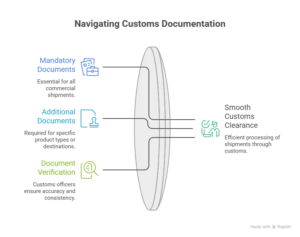
Missing even one document can hold up your entire shipment. Here’s what you need to have ready.
Mandatory Documents
Every commercial shipment needs four core documents. A commercial invoice showing the value, quantity, and description of goods. A packing list with weights and dimensions. A bill of lading or airway bill as proof of shipment. Along with a certificate of origin showing the place of manufacture of the goods.
These four items must be correct, in agreement with each other, and correspond precisely to your customs declaration.
Additional Documents Required Based on Product Type or Destination
Depending on the thing you are shipping, you may need to provide more documents. Restricted goods such as food, pharmaceutical products, or electronics require an import permit or license. Food products need a health certificate. Goods regulated by the Emirates Authority for Standardisation need ESMA approval. Meat and food products require a halal certificate. Shipments going into a UAE free zone have their own specific requirements too.
Check what applies to your product early. Waiting until the shipment arrives to sort permits is how delays happen.
Document Verification and What Customs Officers Check
Customs officers are looking for consistency. They cross-check the value on your invoice against market rates, verify the HS code matches the product description, and confirm the origin is correctly declared.
Undervaluing goods or using an incorrect HS code — even by mistake — can lead to fines, delays, or seizure of the shipment.
Duties, Taxes & HS Codes

How Import Duties and Taxes Are Calculated
The UAE uses CIF — Cost, Insurance, Freight — as the basis for duty calculation. Duties apply to the total value of goods plus shipping and insurance costs combined.
The standard GCC duty rate is 5% on most goods. Alcohol, tobacco, and energy drinks carry higher rates. Certain food items and medical equipment may be exempt. VAT at 5% is then applied on top of the duty-inclusive value.
What HS Codes Are and Why Correct Classification Matters
An HS code is a six-to-eight digit number that identifies exactly what product you’re importing. Every product in the world has one.
Customs uses your HS code to determine the duty rate, check for restrictions, and decide whether an inspection is needed. Get it wrong and you could overpay — or face a penalty for misdeclaration. When in doubt, verify your HS code with a customs broker before you ship.
Who Pays Customs Charges — Importer vs Exporter (Incoterms)
This depends on the Incoterms agreed between buyer and seller. Under DDP (Delivered Duty Paid), the exporter covers all duties and delivery costs. Under DAP or FOB, the importer is responsible once goods arrive.
If you’re selling direct to consumers in the UAE, DDP usually makes more sense. Buyers don’t get hit with unexpected charges on delivery, and your clearance process stays cleaner.
How to Use a Duties and Taxes Calculator Before Shipping
Most customs portals and logistics platforms offer a duties calculator. You enter the HS code, country of origin, and shipment value — and it estimates what you’ll owe.
Do this before you ship, not after. It helps you price correctly, choose the right Incoterms, and avoid surprises at the border.
2025–2026 Tariff Changes Importers Need to Know
The UAE has been updating its tariff schedules as part of broader GCC trade policy changes and its growing free trade agreement network. Recent FTAs with India, Israel, and the UK have introduced preferential duty rates for qualifying goods.
If you’re importing from any of these countries, check whether your products qualify for reduced duties. The savings can be significant.
How Long Does Customs Clearance Take?
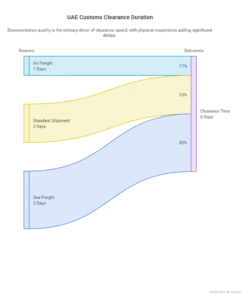
For straightforward shipments with complete, accurate documentation, UAE customs clearance typically takes one to three business days.
Air freight through Dubai tends to clear faster — sometimes within 24 hours. The sea freight at Jebel Ali port will take two to four days.
If your shipment is selected for a physical inspection, you should expect a delay of one to three extra days. In case of controlled or restricted items, the delay may be longer as there might be a need to verify the additional permits.
The single biggest factor in clearance speed is documentation quality. Accurate, complete paperwork moves fast. Incomplete or inconsistent paperwork doesn’t.
Common Challenges That Cause Holds, Delays & Extra Fees

Most customs delays come down to the same handful of issues.
Incorrect or missing documents are the most common cause. A mismatched invoice, a missing certificate of origin, or a wrong bill of lading number will trigger a hold right away.
Wrong HS codes lead to duty recalculations and potential penalties. Undervalued goods get flagged too — customs has market benchmarks, and a declared value that looks too low raises a red flag.
Missing permits stop regulated shipments cold. And payment delays matter too. Duties need to be paid before goods are released, so any hold on payment is a hold on delivery.
Tips for a Smooth Customs Clearance Process

Get Your Paperwork in Order Before Shipping
Don’t wait until your shipment is on a vessel. Have your core documents ready and verified before goods leave the origin country. Errors caught early are much cheaper to fix than errors caught at the port.
Be Aware of Applicable Duties and HS Codes
Know your HS code before you ship. Verify it against the UAE tariff schedule and check if any permits apply to your product category. A few minutes of research upfront can save days of delays.
Consider Switching to DDP (Delivered Duty Paid) for B2C Lanes
If you’re shipping directly to consumers in the UAE, DDP removes friction at delivery. Customers don’t get hit with unexpected charges, and your clearance process is cleaner end to end.
Pre-Determine Taxes Using a Duties Calculator
Use a duties and taxes calculator at the quoting stage. It helps you price accurately, pick the right Incoterms, and avoid any surprises before you commit to a shipment.
Keep Commodity Data Reusable and Standardized
If you ship the same products regularly, build a product library with standardised descriptions, HS codes, and values. It speeds up declaration filing and cuts down on human error over time.
Use Technology to Automate Customs Compliance
Good logistics platforms let you automate document generation, HS code lookup, and compliance checks. The less manual the process, the fewer mistakes make it through.
The Role of a Customs Broker / Clearing Agent

A customs broker — also called a clearing agent in the UAE — acts on your behalf with customs authorities. They file declarations, handle paperwork, pay duties, and manage the clearance process end to end.
For companies that are new to importing in the UAE, or those that are handling complicated or controlled items, a broker is a good investment. They understand how the system works, the local laws, and will find ways to solve any problems that might arise.
Even experienced importers, who are well versed in the business, resort to brokers when dealing with a new product category or a new trade lane. The risk of making a mistake is so high that it is even more expensive to try doing it without anyone. Therefore, you should always collaborate with a licensed agent one who is registered with Dubai Customs, Abu Dhabi Customs or Sharjah Customs, depending on the port location.
What to Do If Your Shipment Is Stuck at Customs

First, don’t panic. Most holds get resolved quickly once you identify the issue.
Contact your customs broker or freight forwarder first. They can pull the status from the customs portal and tell you exactly why the shipment is held.
Common fixes include submitting a missing document, providing a clarification letter, paying outstanding duties, or applying for the right permit. Most issues are paperwork-related and resolve within a day or two.
If your goods have been seized — not just held — you’ll need a licensed customs consultant or legal adviser. Keep all communication in writing and hold onto every document. You’ll need a clear record if you need to appeal or escalate.
Frequently Asked Questions
What does customs clearance mean?
Import clearance is the procedure of obtaining official authorization for importing goods into a country. In the UAE, this involves submitting the necessary documents, paying the customs duties and taxes, and only after such formalities has been done, the goods are released by the customs for delivery.
How long does customs clearance take?
Normally, it takes from one to three working days for simple shipments. However, the processing time may extend to five days or even longer if the goods need to be physically inspected or the documents submitted are found to be incomplete.
Do I need a customs broker?
Not legally, but practically — yes, for most businesses. First of all, brokers lower the number of mistakes; they are very familiar with the procedures and fix problems quickly, unlike someone doing it for the first time.
Can I organise customs clearance myself?
You can, if your business holds a valid trade licence. You’d file declarations directly through the customs portal. Most importers still prefer using a broker.
How do I know my shipment has cleared customs?
Your broker or freight forwarder will notify you. You can also check status on the Dubai Customs or Abu Dhabi Customs portal using your declaration number.
Are customs fees avoidable?
Duties are a legal requirement and generally can’t be skipped. You may qualify for reduced rates under an FTA or exemptions for specific goods. A customs broker can advise on legitimate options.
Conclusion
Customs clearance in the United Arab Emirates should not be a stressful experience. If you have the right papers, use the proper HS codes, and the steps are clear, the shipments will most likely be processed quickly without any issues.
The problems almost always come down to preparation. Get your paperwork right before you ship, know what duties apply, and have the right support in place from the start.
At Triroute Shipping, we help businesses move goods through UAE customs without the guesswork — from documentation and duty calculations to end-to-end freight management across air, sea, and land.